
Cosplay helmet projects demand printers that balance large shells with sharp details. This guide highlights five Amazon-ready options that cater to both bold, durable outer shells and intricate interior details. You’ll find a mix of FDM and resin technology to suit different helmet styles, from oversized Mandalorian visors to ornate, delicate pieces. Each option is evaluated for build volume, print quality, ease of use, and features that help you finish cosplay helmets faster and more consistently.
| Product | Brand | Build Volume (mm) | Type | Notable Strength for Helmets |
|---|---|---|---|---|
| FLASHFORGE Adventurer 5M Pro | FLASHFORGE | 220 x 220 x 220 | FDM | High-speed printing with multi-nozzle options |
| Creality Ender 3 | Comgrow | 220 x 220 x 250 | FDM | Affordable, reliable, good for large outer shells |
| Anycubic Photon Mono 4 | ANYCUBIC | 153 x 87 x 165 | Resin | Fine detail for visors and ornamentation |
| FLASHFORGE AD5M | FLASHFORGE | 220 x 220 x 220 | FDM | One-click auto leveling and fast setup |
| ELEGOO Neptune 3 Pro | ELEGOO | 225 x 225 x 280 | FDM | Auto bed leveling and solid all-metal drive |
FLASHFORGE Adventurer 5M Pro 3D Printer

The Adventurer 5M Pro is designed for rapid iteration, with a maximum travel speed of 600 mm/s and acceleration up to 20,000 mm/s². The nozzle heat-up time of about 35 seconds reduces downtime between helmet prototypes, speeding up concept-to-fit cycles. Its Core XY all-metal frame provides stability during high-speed moves, helping you maintain smooth surfaces on large helmet shells.
With multiple nozzle sizes (0.25 mm, 0.4 mm, 0.6 mm, and 0.8 mm), you can tailor the balance between speed and detail. Pressure-sensing auto bed leveling simplifies first layers, ensuring consistent adhesion without manual adjustments. The dual-sided PEI platform allows quick, tool-free removal of finished parts, which is especially useful when testing multiple visor geometries or interior fittings.
- Build volume: 220 x 220 x 220 mm
- Auto bed leveling with multi-point sensing
- Interchangeable nozzles for speed or detail
- Fast heat-up and stable high-speed motion
Creality Ender 3 3D Printer
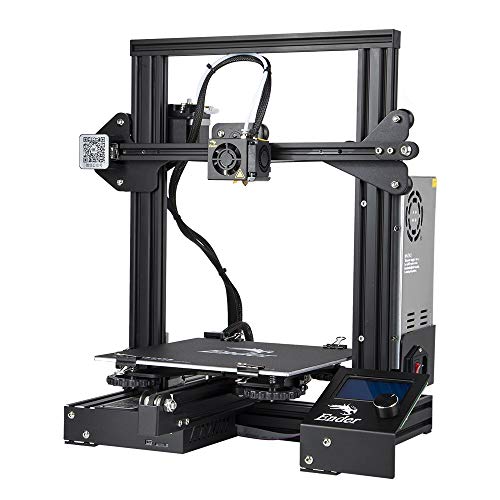
The Ender 3 remains a staple for makers who value reliability and cost-effectiveness. It supports robust builds for helmet shells, with a build volume of 220 x 220 x 250 mm. Its resume printing feature helps recover from outages, and the upgraded extruder reduces filament jams and extrusion inconsistencies—crucial for large, smooth shell surfaces and consistent wall thickness.
While assembly is required, the Ender 3’s open-frame design makes it easy to observe and adjust during print setup. It’s compatible with a wide range of filaments such as PLA and PETG, which are often used for cosplay armor components. For helmets, you can print a lightweight outer shell in PETG and reinforce with post-processing or use PLA for quick prototypes and fittings.
- Build volume: 220 x 220 x 250 mm
- Resume printing after power loss
- Upgraded extruder reduces clogging and stringing
- Requires assembly, but widely supported by communities
ANYCUBIC Photon Mono 4 Resin Printer

For helmet detailing, the Photon Mono 4 shines with a 7-inch 10K Mono LCD, delivering ultra-fine surfaces that are ideal for visor edges, insignias, and intricate ornamentation. The LighTurbo light source provides stable, uniform exposure, reducing layer lines and rasterization for crisper details on small parts such as vents, grills, and decorative accents.
Its maximum print volume is 153.4 x 87 x 165 mm, making it excellent for detailed helmet components, such as visors or small resin inserts. Resin prints typically require post-processing, but they yield exceptional surface quality that’s hard to achieve with larger FDM parts. This makes the Photon Mono 4 a strong companion for finishing helmets with high-precision features.
- 7” 10K resolution for fine details
- LightTurbo matrix for even, high-quality curing
- Print volume of 153.4 x 87 x 165 mm
- Ideal for small, detailed components and visors
FLASHFORGE AD5M 3D Printer

The AD5M builds on FLASHFORGE’s emphasis on user-friendly, high-performance printing. It features a fully automatic one-click bed leveling system that precisely measures nozzle-to-build plate distance, removing manual calibration for consistent first layers. The Core XY all-metal motion structure contributes to reliable, quiet operation even at higher speeds, which is ideal when iterating helmet masks and interior components.
With a 220 x 220 x 220 mm print area and a quick-swap nozzle design, you can switch between fast infill passes and detailed outer shells without sacrificing workflow efficiency. The AD5M is well-suited for builders who want consistent results with minimal setup, particularly when fabricating multiple helmet prototypes or pieces that require precise tolerances.
- Auto bed leveling with one-click offsets
- Core XY all-metal frame for stability
- Quick-swap nozzle system for different tasks
- Reliable for beginners and advanced users alike
ELEGOO Neptune 3 Pro 3D Printer

The Neptune 3 Pro combines a capable build size with smart features. Its 225 x 225 x 280 mm build volume is ample for mid-sized helmet components, and the 36-point auto bed leveling system takes the guesswork out of first layers. The direct drive extruder provides consistent filament feeding, which helps prevent under-extrusion on curved helmet sections and fine-edge details in PETG and PLA.
Ready-to-use out of the box in many cases, it minimizes setup time for rapid helmet iterations. The Neptune 3 Pro is a strong choice for builders who want a balanced, reliable printer with automatic features and a robust print platform suitable for larger helmet pieces and mid-sized accessories.
- Build volume: 225 x 225 x 280 mm
- 36-point auto bed leveling
- Direct drive extruder for reliable feeding
- Pre-assembled with user-friendly workflow
Buying Guide
Choosing a 3D printer for cosplay helmets involves weighing size, detail, durability, and workflow. The right setup often combines two workflows: a larger FDM printer for outer shells and a resin printer for fine details. Consider these key purchase considerations to tailor a setup to your helmet project goals.
- Printer type and helmet needs: FDM printers excel at larger shells and tough plastics like PETG and ABS-like materials, while resin printers deliver high-resolution details for visors, insignias, and ornate surfaces. For most helmet builds, a capable FDM printer with a large build volume is essential, complemented by a resin printer for detailed accents.
- Build volume and enclosure: A bigger build area makes it easier to print full helmet shells in one piece or in large segments. Enclosures reduce noise, improve safety, and help control odor with certain materials. If your helmet design is bulky, prioritize a printer with at least 220 x 220 x 250 mm or larger.
- Auto leveling and ease of use: Auto bed leveling and user-friendly interfaces save time and reduce failed prints, especially for beginners. Consider models with one-click calibration and reliable bed adhesion features to minimize retries.
- Material compatibility: Filament choices (PLA, PETG, ABS-like,/resin) determine durability and post-processing steps. PETG or ABS-like plastics yield stronger outer shells, while PLA remains easy to print. Resin is best for fine details but requires post-processing steps like washing and curing.
- Detail versus productivity: For intricate visor designs or decorative elements, resin printing or hybrid workflows can deliver crisper edges. For larger shells, a fast, multi-nozzle FDM printer reduces iteration time while maintaining acceptable surface quality.
- Post-processing workflow: Resin prints need washing and curing; FDM parts may require sanding, priming, and painting. Plan your workflow to avoid bottlenecks between printing and finishing stages.
- Support and ecosystem: A strong user community and accessible spare parts can shorten troubleshooting. Popular models—like those represented here—benefit from abundant tutorials, upgrade parts, and community-made profiles for cosplay pieces.
- Reliability and maintenance: Look for robust frame design, quality drive mechanics, and available service options. A stable printer reduces print failures during long helmet builds and helps maintain consistent results across multiple pieces.
In practice, many cosplayers pair an FDM printer with a resin printer to cover both shells and fine details. For example, you might print a large helmet shell on an Ender 3 or Neptune 3 Pro, then add finely detailed faceplates, vents, or trim with a Photon Mono 4. Choosing a workflow that fits your project scale, skill level, and finishing time will yield the best overall results while keeping production on schedule for conventions and photoshoots.