
Advancements in 3D wax printing have unlocked precise, repeatable patterns for lost-wax casting in jewelry making. Castable resins and high-wax content materials are engineered to burn out cleanly, minimizing ash and surface defects on final pieces. The following picks balance printability, burn-out performance, and fine detail—covering popular resins from trusted brands and a solid wax carving option for traditionalists. Use these selections as starting points to compare how each material performs with your printer and in your casting workflow.
| Product | Brand | Resin Type | Notable Benefit |
|---|---|---|---|
| Siraya Tech Castable Resin True Blue | Siraya Tech | Castable Resin | Easier burn-out; high resolution; good for thicker parts |
| JAMG HE Jewelry Castable Resin | JH JAMG HE | Castable Resin | High wax content; smooth surface; beginner-friendly |
| Funcrecol Castable Resin | FUNCRECOL | Castable Resin | Low ash; easy printing and curing; detailed castings |
| Magforms RC800 Resin | Magforms | 8K/12K Castable Resin (RC800) | Ultra-high precision; low shrinkage; easier post-processing |
| 1 Pound Blue Carving Wax Block | Djcoolbe | Wax Block | Varied block sizes; ideal for hand carving and lost-wax patterns |
The products below are the five most relevant options for jewelry-focused 3D wax work, covering both castable resins designed for auto-burn-out and a traditional carving wax alternative for hands-on workflows.
Siraya Tech Castable Resin True Blue

- Easier to burn and clean; wax content helps reduce ash during burnout for thicker designs like bracelets or large pendants.
- Easier to print; forgiving in real-world environments without very dry conditions or special additives, with good plate adhesion and high resolution.
- Widely used and compatible with most LCD, DLP, and SLA printers; marketed for casting jewelry and metal parts.
JAMG HE Jewelry Castable Resin

- High wax content designed for easier casting; supports thicker parts and reduces skill barriers for beginners.
- Smooth surface with strong casting performance; reduces risk of cracks during mold making and investment casting.
Funcrecol Castable Resin
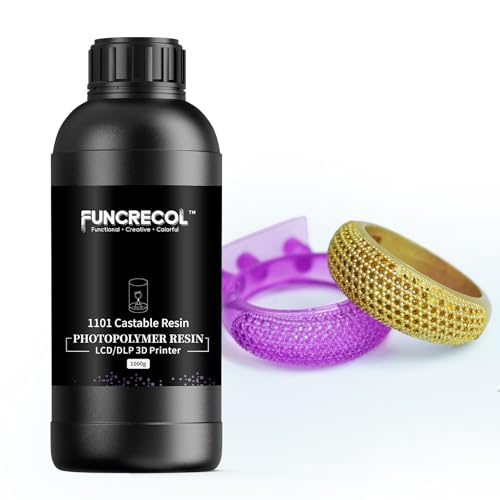
- High-resolution castable resin designed for jewelry; smooth curing and reliable results with no special additives or dry conditions.
- Low ash content during burnout, supporting clean, high-quality castings; marketed for professional use and higher yield production.
Magforms RC800 Resin

- High hardness and toughness for durable patterns with intricate details; designed to deliver precise results for jewelry and miniatures.
- Ultra-high precision with low shrinkage; ceramic-like matte finish helps hide layer lines and improve visual inspection of details.
- Low odor and easier post-processing; easier to clean and handle compared to older resin formulas.
1 Pound Blue Carving Wax Block

- 1 Pound total, consisting of 15 pieces in multiple widths and lengths for varied carving tasks.
- Melts around 158 F (70 C), suitable for hand carving and pattern creation for lost-wax casting.
- Durable enough for detailed shaping and forming of intricate jewelry designs before investing in casting.
Buying Guide
Material Type And Casting Goals
Jewelry casting workflows hinge on material selection. Castable resins are engineered to burn out cleanly with minimal residue, which helps produce high-fidelity metal impressions. Wax blocks remain a staple for hand-carved patterns and traditional lost-wax workflows. If your focus is automated printing and thin-to-thick parts with many replicates, castable resins are typically more efficient. For bespoke, one-off designs or prototyping, wax blocks provide tactile control and immediate pattern creation without a printer.
Wax Content And Burn-Out Quality
Higher wax content generally improves burn-out quality by reducing ash and allowing cleaner metal casting. Look for resins that explicitly mention easy burn-out, low ash content, or complete combustion. For thicker components like bangles or substantial pendants, prioritize materials that emphasize burn-out performance and stability during the burnout cycle to minimize surface defects.
Printer Compatibility And Resin Type
Most jewelry-focused castable resins are designed for LCD, DLP, or SLA printers with 405 nm curing. Verify compatibility with your printer model, as some resins advertise broad printer support while requiring adjustments in print settings, peel dynamics, or post-curing times. If you are using a mono LCD or a high-resolution printer, ensure the resin’s viscosity and plate adhesion align with your hardware to maximize success rates.
Post-Processing And Safety
Post-processing steps—washing, curing, and burnout—vary by resin. Some resins cure quickly and require minimal post-processing, while others demand longer UV exposure or specialized cleaning routines. Odor, solvent use, and glove requirements are practical considerations for home studios. Select materials with documented post-processing workflows that fit your available equipment and safety practices.
Cost, Availability, And Supplier Support
Price and ease of procurement influence long-term projects. Castable resins and wax blocks come in varying pack sizes, with 500 g to 1 kg options common for resins and 1 lb blocks for wax. Consider the total cost per finished part and the availability of refills, along with brand support, documentation, and community guidance to troubleshoot issues quickly.
Practical Recommendations For Jewelry Casting
For most jewelry casters, a combination approach works well. Use a castable resin with high burn-out performance for production runs and a wax block for bespoke, hand-carved components or initial pattern development. Maintain consistent cure schedules, test prints on your printer, and calibrate with wax patterns that reflect your final design features. When transitioning between materials, run a small pilot series to evaluate burnout behavior and surface finish before scaling up.
Comparative Perspectives
- For multi-part, high-detail pieces: castable resins like Siraya Tech True Blue and Magforms RC800 offer strong burn-out performance and dimensional stability at high resolutions.
- For beginners or quick-turn prototypes: high-wax-content resins such as JAMG HE provide easier casting and smoother results with less required skill.
- For traditionalists or hands-on artisans: carving wax blocks enable direct shaping and adjustments without relying on a printer, facilitating rapid iteration in the early design phase.
Choosing the right combination depends on your workflow, target piece complexity, and whether you prioritize production speed or artisanal control. The five options highlighted above are representative of current market capabilities and cater to a broad spectrum of jewelry casting needs.