
When repairing plastic-to-plastic assemblies, choosing the right epoxy or putty matters. This guide reviews top-rated epoxy products designed for plastics, including putty sticks and clear epoxy adhesives. It covers performance, curing times, temperature tolerance, and practical repair scenarios to help DIYers, homeowners, and professionals make informed choices. The selections below emphasize direct bonds to common plastics such as ABS, PVC, CPVC, and various polymers, with an eye toward durable, non-shrinking results that can be drilled, sanded, or painted after curing.
| Product | Brand | Best For | Notable Feature |
|---|---|---|---|
| PlasticWeld | J-B Weld | Direct plastic-to-plastic repair | 600 psi lap shear; NSF potable water safety |
| Plastic Glue Clear Epoxy | vicpricme | Clear bonds on plastics | 1:1 syringe; -65°F to 548°F |
| Epoxy Putty Fast Repair | Limino | Underwater and above-water repairs | 8 min start; 24 hr full cure |
| Epoxy Putty Black | Endhokn | Leaking cracks and holes in plastics and metal | Non-shrinking; drillable and paintable |
| Metal Repair Epoxy Glue | KEWEIYOW | Bonding metals and plastics | 5 min set; -65°F to 548°F; up to 4680 psi |
PlasticWeld: J-B Weld Plastic Repair Epoxy Putty

J-B Weld PlasticWeld is a hand-mixable two-part epoxy putty designed for on-the-go plastic repairs. It’s formulated for ABS, PVC, CPVC pipes, automotive bumpers, and other plastics, offering a non-shrinking, moldable repair that can be shaped to fit seams and holes. After kneading, it begins to set in about 25 minutes and reaches a full cure in around three hours, making it practical for quick DIY fixes. The cured material delivers a lap shear strength near 600 psi and tolerates continuous temperatures up to 250°F (121°C) and up to 300°F (148°C) intermittently. It is NSF-certified for potable water contact, broadening its use in home plumbing projects and outdoor repairs.
- Type: Hand-mixable two-part epoxy putty
- Cure: ≈3 hours full cure; 25 min set
- Temperature: Up to 250°F continuous, 300°F intermittent
- Surface compatibility: ABS, PVC, CPVC, plastics; automotive applications
Clear Plastic Epoxy Glue By Vicpricme
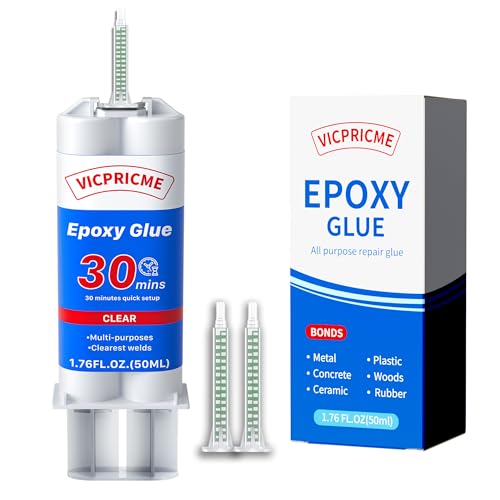
Vicpricme’s Plastic Glue is a clear two-part epoxy adhesive designed for dependable plastic bonding and compatible with other common substrates. The product is packaged as a 1.76-ounce syringe with a reusable cap, a 1:1 mixing ratio, and a static mixer, which helps achieve uniform bonding without guesswork. It sets to handle in roughly 30 minutes and fully cures in about 24 hours. Once cured, the bond remains robust across a wide temperature range, from -65°F to 548°F (-54°C to 287°C). The cured adhesive can be drilled, sanded, and painted, making it suitable for visible cosmetic repairs as well as functional fixes.
- Mix ratio: 1:1; includes static mixer and cap
- Set/Cure: ~30 minutes to handle; 24 hours full cure
- Temp range: -65°F to 548°F (-54°C to 287°C)
- Applications: Plastics, metals, wood, ceramics, and more
Epoxy Putty Fast Repair By Limino

Limino’s Epoxy Putty Fast Repair is a hand-mixable two-part clay designed for a broad range of repairs, including plastic, metal, tile, ceramics, and wood. It is formulated to work both underwater and above water, offering a versatile option for plumbing, automotive, and household repairs. The putty hardens quickly—roughly eight minutes to begin setting, with a full cure in about 24 hours. It forms a durable, non-shrinking surface that can be drilled, sanded, and painted after curing, and it tolerates a wide temperature range from -50°C to 130°C, making it suitable for challenging environments.
- Two-part epoxy putty; underwater capability
- Quick set: starts in ~8 minutes; cure in ~24 hours
- Temperature range: -50°C to 130°C
- Bonding: Plastic, metal, ceramics, wood, and more
Epoxy Putty Black Putty Stick By Endhokn

Endhokn’s Epoxy Putty Black Putty Stick is a multipurpose two-part epoxy putty designed for repairs on metal, ceramics, plastics, and wood. It excels in both underwater and above-water applications, making it a flexible option for leaks, cracks, and holes in various substrates. The putty cures to a non-shrinking, solid mass that can be drilled, sanded, and painted after complete curing. This makes it a practical choice for water-exposed repairs, outdoor furniture, plumbing components, and automotive fixes where a robust, gap-filling repair is needed.
- Two-part epoxy putty; underwater suitability
- Non-shrinking cure; machinable after cure
- Applications: Metal, ceramics, plastics, wood
- Surface finish: Drillable, paintable after cure
Keweiyow Metal Repair Epoxy Glue

Keweiyow Heavy Duty Epoxy Metal Glue is a two-component adhesive designed for a wide range of bonding tasks that involve metal but also plastics and ceramics. It cures quickly, with initial set in about five minutes and a full cure in roughly 24 hours. The bond offers high-temperature and oil resistance, maintaining integrity from -65°F to 548°F (-54°C to 287°C). Cured joints are drillable, sandable, and paintable, making this product suitable for automotive, plumbing, and general purpose repairs where a robust metal-to-plastic or metal-to-metal bond is needed.
- Two-part syringe; 1:1 mix ratio
- Set time: around 5 minutes; cure time: ~24 hours
- Temp range: -65°F to 548°F (-54°C to 287°C)
- Bond strength: high-adhesion formulation suitable for metal and plastics
Buying Guide
Choosing the right epoxy for plastic-to-plastic repairs depends on how you plan to use the bond, the plastics involved, and the environmental conditions. The following considerations help compare options across putty, clear epoxy, and multi-material glues:
- Bond type and application: Putty-based products are great for gap filling and irregular surfaces, and they often cure with strong, moldable bonds that resist warping. Clear epoxies provide a neat cosmetic finish and are ideal for visible repairs where color matching matters.
- Plastic compatibility: Not all epoxies claim universal plastic adhesion. Check for compatibility with ABS, PVC, CPVC, polyolefins, and other common plastics used in household items and plumbing. Some products explicitly target plastic-to-plastic bonds, which is ideal for this use case.
- Cure time and workflow: If you need a quick set for containment or limited downtime, a faster-set epoxy or putty offers a shorter window before handling. For structural, long-term repairs, a slower cure with higher final strength may be preferable.
- Temperature and chemical exposure: Consider environments where the repaired part will face heat, oil, water, or chemicals. Epoxies rated for high temperatures and chemical resistance typically perform better in automotive or plumbing contexts.
- Water exposure and underwater capability: For leaks or submerged surfaces, choose putty or epoxy with underwater curing capability and waterproof properties to prevent seepage and maintain seal integrity.
- Workability and finish: Clear epoxies reduce visibility on transparent plastics, while putties allow shaping around irregular gaps. Drilling, sanding, and painting after curing can influence which product you choose for cosmetic vs. functional repairs.
- Safety and handling: Read the safety data sheets for venting requirements and skin/eye protection. Adequate ventilation and appropriate PPE help minimize exposure to fumes during mixing and curing.
- Packaging and reuse: Syringe-based systems (1:1 mix) offer precise dosing and reuse potential, whereas putty sticks provide a simpler, self-contained option with less equipment.
In practice, the best choice depends on specific repair goals. For quick, direct bonds between plastic surfaces, a dedicated plastic epoxy putty like PlasticWeld often delivers high strength with relatively simple handling. For visible repairs or applications requiring a clear bond, a transparent epoxy such as Vicpricme’s Plastic Glue can be advantageous. When facing gaps, holes, or underwater repairs, Limino and Endhokn putties offer flexible, non-shrinking options that cure to firm, drillable finishes. Finally, for multi-material projects or metal-to-plastic needs, KEWEIYOW provides a fast-set, high-strength solution with broad temperature tolerance. Always follow surface prep steps: clean, dry, and roughen plastics as needed for optimal adhesion.
Tip: If you’re unsure which product fits your plastic type, test the adhesive on a small area or a scrap piece of the same plastic to evaluate cure behavior and finish before committing to the full repair.