
Choosing a laser cutter or engraver specifically for acrylic requires balancing power, accuracy, and workspace. Acrylic projects benefit from steady, clean cuts and fine engraving detail, whether you’re creating signs, decorative pieces, or prototypes. The following five models stand out for acrylic work, combining reliable performance with features that matter for hobbyists and small studios. This guide highlights what to look for and how each option stacks up across common use cases, from beginner-friendly setups to more expansive, professional-grade machines.
| Product | Brand | Notable Strength | Working Area | Power |
|---|---|---|---|---|
| Longer Ray5 5W | Longer | High speed, 0.01 mm engraving precision | 400×400 mm | 5W |
| Carverall K15 Pro 5W | Carverall | Ultra-precise 0.01 mm engraving | 200×300 mm | 5W |
| xTool P2S 55W CO2 | xTool | Large bed, dual 16MP cameras, autofocus | 26″ x 14″ | 55W CO2 |
| Creality Falcon 10W | CREALITY | Rotary support and safety features | Not specified | ~10W |
| Longer Ray5 3.5W | Longer | Portable, precise 0.04×0.04 mm engraving | 130×140 mm | 3.5W |
Note: The five selections above are chosen for their balance of acrylic-ready performance, reliability, and user convenience. They range from compact, desk-friendly units to larger, more versatile setups that can handle bigger acrylic projects. Each option supports engraving or cutting acrylic to varying thicknesses, so match your intended project size and material thickness to the machine’s capabilities.
Longer Ray5 5W: High-Speed Laser Engraver

The Longer Ray5 5W laser engraver is built around a 240MHz ESP32 core, delivering speeds up to 10,000 mm/min. It features a 0.08×0.08 mm laser dot and an engraving tolerance of 0.01 mm, enabling fine lines and detailed patterns on acrylic. With a spacious 400×400 mm working area, it supports mid-sized projects and accommodates multiple pieces in a single session. A 3.5″ touch screen provides quick, independent control, and the unit supports offline operation for convenient, tool-free use away from a PC. This model suits acrylic signs, jewelry components, and decorative panels that demand accuracy and speed.
In practical acrylic work, the Ray5 excels at precise lines and smooth edge finishes. The larger bed size reduces the number of passes needed for panels and panels with openings. While 5W is typically sufficient for engraving and light cutting in acrylic up to certain thicknesses, deeper cuts or thicker sheets may require multiple passes or alternative setups. The offline capability is helpful for workshop environments where a PC isn’t always available, and compatibility with common software broadens its appeal for hobbyists and makers.
Carverall K15 Pro 5W Laser Engraver
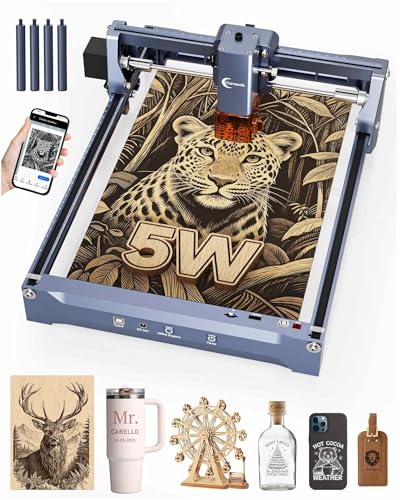
The Carverall K15 Pro delivers true 5W output with remarkable engraving precision, up to 0.01 mm, and a top engraving speed of around 15,000 mm/min. Its compact 200×300 mm working area is well-suited for detailed acrylic signs, jewelry components, and decorative pieces. The device ships fully assembled, reducing setup time, and includes a focusing block for quick focal length adjustments. It integrates with broad software ecosystems and supports Windows, Mac, Android, and iOS through CutLabX, LightBurn, and similar platforms. This model blends accuracy with ease of use for acrylic accents and craft projects.
For acrylic applications, the K15 Pro offers clean, precise engraving with dependable repeatability. The 5W class power enables fine lines and light cutting on thinner sheets, making it a good fit for plaques, photo frames, and decorative acrylic panels. The quick assembly and broad software compatibility help users transition from beginner projects to more complex designs. Users should consider the working area when planning larger acrylic pieces and evaluate whether additional accessories, such as a rotary attachment, are needed for cylindrical items.
Creality Falcon 10W Laser Engraver

The Creality Falcon 10W laser engraver features a higher power output with safety considerations, including an anti-UV filter on the module and an emergency stop. It’s designed for rapid work with materials like wood and acrylic, including deep engraving and cutting tasks. The 4-in-1 Rotary Kit Pro expands capabilities for cylindrical items, while the modular assembly process (10–20 minutes) makes it accessible to newcomers. The unit supports a broad range of surfaces and can handle cylindrical objects with precision, making it well-suited for acrylic tumblers, signs, and multi-face designs.
For acrylic projects, Falcon’s higher power enables faster processing and cleaner edges on larger or thicker sheets, especially when cutting or engraving the outer shapes of signs or display pieces. The rotary option is advantageous for rounded acrylic items, such as tumblers, while the safety features help maintain a secure workspace. Always verify enclosure requirements and ventilation, as higher power devices generate more fumes and dust during operation.
xTool P2S 55W CO2 Laser Cutter

The xTool P2S 55W CO2 laser cutter is a workspace-scale option with a large 26″ x 14″ bed and enhanced airflow for cleaner cuts and engravings. Dual 16MP cameras provide high-resolution real-time previews, while LiDAR-based autofocus (0.001″) supports precise focusing. A notable feature is the Auto-Passthrough system for materials up to 118″ long, plus a riser base for taller objects. It also supports a rotary option (RA2 Pro) for tumblers and curved items. This model is a strong choice for acrylic, especially when cutting larger panels or signs with accurate, consistent edges.
When using acrylic with CO2 systems like the P2S, expect robust cutting performance on clear and colored sheets, with cleaner kerf and smoother edges compared to many diode-based setups. The advanced cameras and autofocus help with alignment on complex patterns, while the expanded bed and long-pass-through support bigger projects. Audience considerations include space, ventilation, and the incremental cost of maintenance and replacement parts that CO2 systems may require over time.
Longer Ray5 3500mW: High-Precision Compact Engraver

The Longer Ray5 3500mW model offers a compact footprint with solid engraving prowess. It boasts a 0.04 x 0.04 mm laser spot and a maximum speed of 12,000 mm/min, enabling detailed work on acrylic and other materials within a 130×140 mm working area. The unit ships as an integrated package, ready to use out of the box, with a focus block to simplify focal length adjustments. This setup is ideal for small plaques, jewelry components, and intricate acrylic patterns where precision and portability matter most.
For acrylic projects, the 3.5W-class Ray5 can deliver crisp engravings with fine lines and consistent depth. It’s particularly strong for detailed designs on small items or panels, where accuracy and repeatability are important. While the working area is modest, the device’s portability makes it a convenient option for hobbyists who want a dedicated acrylic engraver without committing to a larger benchtop system. Prospective buyers should consider whether the 130×140 mm area suits their typical project size and whether occasional upgrades are desirable for thicker materials.
Buying Guide
Laser Type And Materials
CO2 lasers typically excel at cutting and engraving clear acrylic, especially thicker sheets, while diode-based machines are often superb for engraving but may require multiple passes for cutting thicker acrylic. For frequent cutting tasks, a CO2 system with a reliable beam and good optical alignment is usually the most versatile choice. If your projects emphasize intricate engraving on acrylic with minimal thickness, high-precision diode systems can be effective as well.
Power, Speed And Precision
Power ranges from about 3.5W to 55W in the selections here. Higher power generally enables faster cutting or deeper engraving, but it can also raise cost, footprint, and safety requirements. For acrylic, 5W to 10W devices are often sufficient for engraving and light cutting on thinner sheets, while 55W CO2 units handle thicker cuts and faster throughput. Precision is typically expressed as the smallest engravable feature and the repeatability of results; look for stated tolerances around 0.01 mm to 0.04 mm for acrylic work.
Working Area And Material Handling
Bed size dictates how large a project you can complete in a single pass. The 400×400 mm and 200×300 mm beds cover mid-sized signs and panels, while large-format options like a 26″ x 14″ bed expand capabilities for bigger acrylic pieces. Consider also whether the machine supports Auto-Passthrough or a rotary attachment for cylindrical items, as these features dramatically broaden acrylic project possibilities.
Software, Compatibility And Ease Of Use
Software compatibility matters for workflow efficiency. Look for support for popular programs like LightBurn, LaserGRBL, and CutLabX, as well as cross-platform compatibility (Windows, macOS, Android, iOS). A fully assembled or easy assembly process reduces setup time, and a straightforward user interface helps beginners achieve solid results faster. Some models include offline operation or direct touchscreen control for stand-alone use, which can be convenient in busy workshops.
Safety, Maintenance And Support
Eye protection, emergency stops, UV or infrared safety features, and adequate ventilation are essential for safe operation. Enclosures reduce dust and fumes, while accessible maintenance parts—like replacement lenses, air assist nozzles, and fans—affect long-term reliability. Warranty length and access to customer support influence long-term satisfaction, especially for hobbyists new to laser technology.
Comparative Takeaways
For acrylic-focused work, a CO2 system with a sizable bed and robust autofocus provides the most versatility for cutting and engraving larger pieces. High-precision diode systems deliver excellent engraving detail on smaller items with lower upfront costs. If you need to work with cylindrical acrylic objects, prioritize a rotary kit and compatible software. Finally, always factor in room size, ventilation, and dust collection when selecting a setup to ensure a safe and efficient workspace.
In summary, choosing among these five options depends on your typical project size, whether you prioritize cutting thickness, and how much you value features like offline operation, rotary attachments, or camera-assisted alignment. Each model offers a distinct balance of power, precision, and convenience to help you achieve clean acrylic cuts and crisp engravings in a practical American workshop setting.